
Introduction
Most people have heard of AI. They’ve used a chatbot, tried an image generator, or asked a voice assistant for directions. But there’s a version of AI operating at a completely different level, one that’s reshaping entire industries, governments, and economies.
It’s called massive AI. And if you haven’t started paying attention to it yet, now is a good time to start.
This guide explains what massive AI actually means, how it works at scale, where it’s already being used, and what it means for businesses and individuals in practical terms. No jargon. No hype. Just clear, useful information.
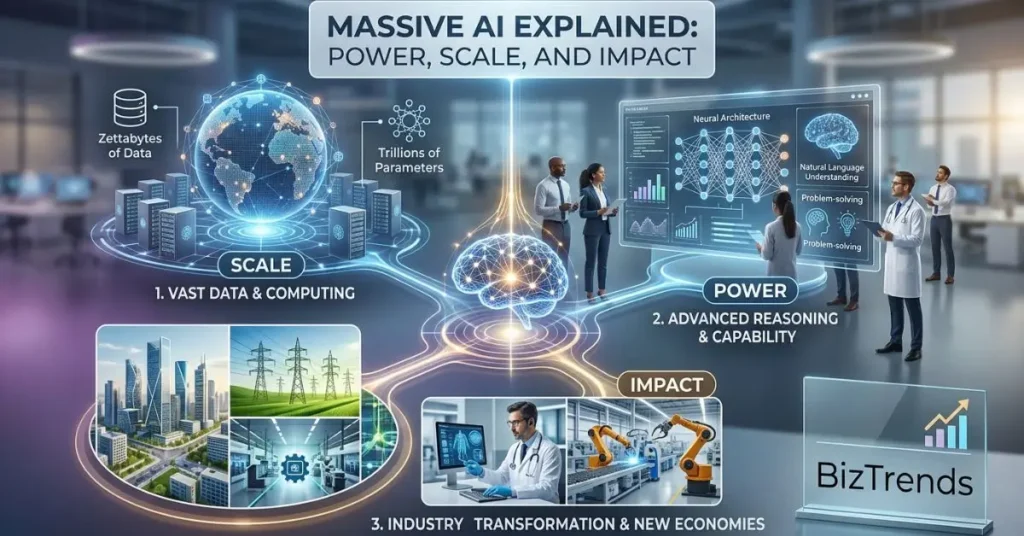
This AI refers to artificial intelligence systems built and deployed at an enormous scale, trained on billions or trillions of data points, powered by thousands of specialized processors, and capable of performing complex tasks across multiple industries simultaneously. These are not simple automation tools. They are large-scale AI infrastructures that drive decisions, generate content, analyze data, and operate continuously across global networks.
Quick Summary
Massive AI is large-scale artificial intelligence operating across industries from healthcare and finance to logistics and media. It’s already here, already influential, and understanding it helps you make smarter decisions about technology, business, and the future of work.
The Difference Between Regular AI and Massive AI
Not all AI is equal. The AI that autocorrects your texts is very different from the systems running behind major financial markets or powering large language models like GPT-4.
Here’s the clearest way to think about it:
Regular AI handles specific, narrow tasks. It’s trained on a defined dataset to do one thing well: recognize faces, recommend products, or filter spam.
Massive AI operates across many tasks, many domains, and many users at once. It’s trained on enormous datasets, runs on powerful computing infrastructure, and its outputs affect millions of people simultaneously.
The scale changes everything: the capability, the risk, the cost, and the responsibility that comes with it.
What Makes AI “Massive”
Three things define whether an AI system qualifies as truly large-scale:
1. Data volume
Massive AI systems are trained on staggering amounts of data. GPT-4, for example, was trained on hundreds of billions of words pulled from books, websites, academic papers, and more. This breadth of data is what allows it to perform across such a wide range of tasks.
2. Compute power
Training an AI model requires thousands of specialized chips called GPUs or TPUs running for weeks or months. NVIDIA has become one of the most valuable companies in the world largely because its chips power this infrastructure. The cost of training a single large AI model can run into tens or hundreds of millions of dollars.
3. Deployment scale
AI doesn’t just train in a data center and sit there. It’s deployed to millions of users, embedded into products, and integrated into critical systems. When ChatGPT hit 100 million users in two months, that deployment scale was itself a signal of how large these systems operate.
Where Massive AI Is Already Working
This isn’t theoretical. Massive AI is actively operating in several sectors right now.
Healthcare
AI systems trained on millions of medical records and imaging scans are helping doctors detect diseases earlier and more accurately. Google’s DeepMind developed an AI that detects over 50 eye diseases from retinal scans with accuracy matching expert ophthalmologists. AI is also accelerating drug discovery. What used to take years of lab testing can now be simulated in days.
Finance
Large-scale AI runs continuously across global financial markets analyzing patterns, flagging fraud, executing trades, and assessing credit risk. JPMorgan Chase uses AI to review commercial loan agreements. A task that previously took lawyers 360,000 hours per year now takes seconds.
Media and Content
Every major streaming platform, Netflix, Spotify, and YouTube, uses AI recommendation systems that analyze billions of data points to decide what you see next. These systems don’t just suggest content. They actively shape what becomes popular and what gets buried.
Government and Defense
Governments are investing heavily in large-scale AI for national security, infrastructure monitoring, and public services. The US Department of Defense has ongoing AI programs for logistics, threat detection, and intelligence analysis. This is an area where scale and risk intersect in significant ways.
Retail and Logistics
Amazon’s entire fulfillment operation runs on AI from inventory prediction to warehouse robotics to delivery routing. Walmart uses similar systems to manage supply chains across thousands of stores. The efficiency gains are real, but so is the workforce impact.
The Real Costs Behind Massive AI
It’s easy to see the output of AI and forget what it takes to run it.
Energy consumption is one of the biggest concerns. Training a single large AI model can consume as much electricity as hundreds of homes use in a year. As AI scales, so does its energy footprint. Microsoft, Google, and Amazon are investing in nuclear and renewable energy specifically to power their AI infrastructure.
Financial cost is another reality. Only a handful of companies, primarily in the US, China, and a few parts of Europe, can afford to build and maintain truly advanced AI systems. This creates a concentration of power that raises legitimate questions about access and competition.
Human labor often sits quietly behind the scenes. AI systems require human annotators, reviewers, and trainers to function well. Much of this work is outsourced to lower-wage workers globally, a part of the AI story that doesn’t get enough attention.
Massive AI and the Business World
For most businesses, directly building an AI system isn’t the point. The point is knowing how to use the outputs and how to stay competitive as these systems reshape industries.
Here’s what that looks like practically:
Access through APIs and platforms. Companies like OpenAI, Google, and Anthropic make their large-scale AI accessible through APIs. A small marketing agency in Denver can now use the same underlying AI model as a Fortune 500 company. The playing field isn’t perfectly level, but it’s more accessible than it’s ever been.
Workflow integration. Businesses are embedding AI into CRM systems, customer support tools, HR platforms, and financial software. The AI does the heavy analytical lifting; humans make the final calls.
Competitive pressure. Industries where AI creates efficiency gains will see pressure on businesses that haven’t adopted it. This is already visible in legal services, financial advising, content creation, and medical diagnostics.
The businesses that understand what AI can and can’t do and integrate it thoughtfully are the ones that will stay ahead.
What Massive AI Can’t Do
Being clear about limits matters.
It can be wrong confidently: Large-scale AI systems sometimes produce incorrect information with full confidence. This is called hallucination, and it’s a real and ongoing issue. Any output used for important decisions should be verified.
It doesn’t understand; it predicts. AI doesn’t think the way humans do. It identifies patterns in data and predicts likely outputs. That’s powerful, but it’s not the same as understanding, judgment, or wisdom.
It reflects its training data: If the data it was trained on contains bias, the AI will likely reproduce that bias. This is a known problem in hiring tools, facial recognition, and credit scoring systems.
It’s not always accessible: Despite wider API access, the cost of integrating large-scale AI tools is still a barrier for many small businesses and organizations in lower-income regions.
A Snapshot: Key Massive AI Systems in Use Today
| AI System | Developer | Primary Use |
|---|---|---|
| GPT-4 / ChatGPT | OpenAI | Writing, research, coding, customer service |
| Gemini Ultra | Google DeepMind | Search, enterprise tools, multimodal tasks |
| Claude 3 | Anthropic | Document analysis, long-form reasoning |
| Grok | xAI (Elon Musk) | Real-time information, social media integration |
| Llama 3 | Meta | Open-source, research, enterprise deployment |
Conclusion
Massive AI isn’t a future concept. It’s running right now behind the apps you use, the financial systems you interact with, the healthcare decisions being made, and the content you consume every day.
Understanding it doesn’t require a computer science degree. It requires curiosity and a willingness to stay informed. The people and businesses that grasp what large-scale AI can do and where its limits are will be better positioned for everything that comes next.
FAQ: People Also Ask
What is massive AI in simple terms?
Massive AI is artificial intelligence at an enormous scale trained on vast data and used by millions across multiple industries. ChatGPT, Google Gemini, and Amazon’s logistics network are real examples. Scale is what separates it from basic automation tools.
How is massive AI different from regular AI?
Regular AI does one specific task. This AI handles many tasks across many domains simultaneously, trained on far larger datasets and deployed globally. The difference is like a pocket calculator versus a supercomputer same concept, completely different capability.
Which companies are leading in large-scale AI?
OpenAI, Google DeepMind, Microsoft, Meta, and Anthropic lead in the US. Baidu and Alibaba dominate in China. Most businesses don’t build their own; they access AI through these companies’ platforms and APIs.
Is this AI dangerous?
It carries real risks of misinformation, biased decisions, job displacement, and power concentrated in few hands. These aren’t reasons to avoid it, but reasons to use it carefully. The US, EU, and UK are all actively developing AI regulation.
Can small businesses benefit from massive AI?
Absolutely. Tools like ChatGPT, Copilot, and Gemini give small teams access to the same underlying technology as large enterprises. You don’t need to build your own AI; just pick tools that solve real problems in your workflow.