
Emerging Technologies in 2026
Technology doesn’t wait. While most people are still catching up with yesterday’s tools, the next wave is already building, and it’s moving faster than most people expect.
The problem isn’t access to information. It’s knowing which technologies actually matter, which ones are overhyped, and how any of this connects to real life, your job, your business, and your industry.
That’s exactly what this guide covers. No jargon. No fluff. Just a clear, honest look at the emerging technologies in 2026 that are worth paying attention to and why.
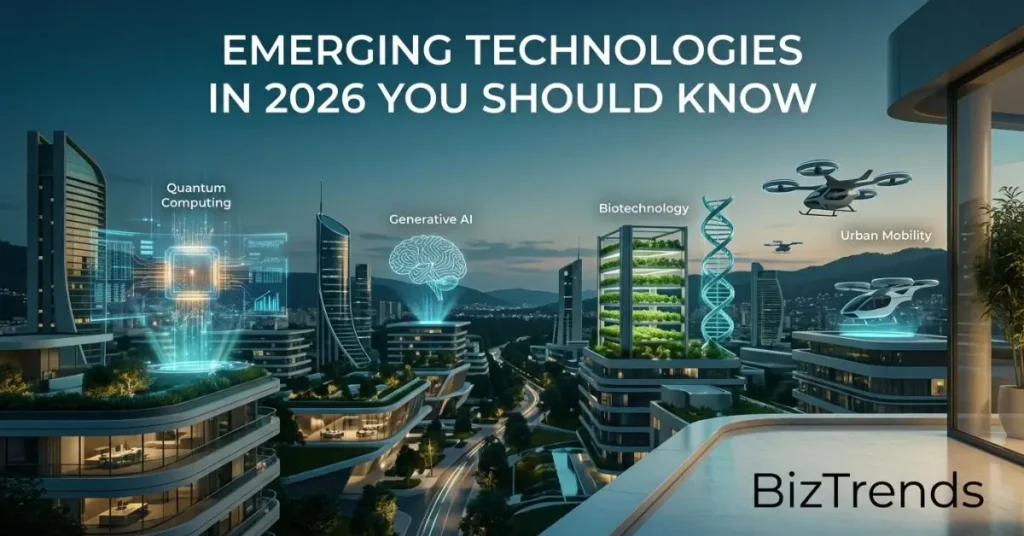
Emerging technologies are new or rapidly evolving innovations that are beginning to move from research and early adoption into mainstream use. In 2026, this includes advances in artificial intelligence, energy, computing, and human-machine interaction technologies that are actively reshaping industries, not just promising to someday.
Quick Summary
Several major technologies are hitting their stride in 2026: AI agents, quantum computing, energy storage, augmented reality, and more. This guide explains each one clearly, with real examples and honest context about what’s ready now versus what’s still developing.
Why 2026 Is a Turning Point for Tech
Every few years, there’s a moment when multiple technologies mature at the same time. That’s what’s happening now.
AI got smarter. Chips got faster. Renewable energy got cheaper. Connectivity got wider. These things didn’t happen in isolation; they’re feeding into each other, and the combined effect is significant.
For businesses and professionals, this isn’t just interesting news. It’s a signal about where investment is going, which skills will matter, and which industries are about to change. Understanding the emerging technologies in 2026 isn’t about being a tech enthusiast. It’s about staying informed in a world that’s moving quickly.
AI Agents – AI That Actually Does Things
Most people have used an AI chatbot by now. You type a question, and it gives an answer. That’s helpful, but it’s still passive.
AI agents are different. They don’t just respond; they act. An AI agent can be given a goal and then figure out the steps to reach it on its own. It can browse the web, fill out forms, book appointments, write and send emails, analyze data, and make decisions without someone guiding every step.
Think of it this way: a chatbot answers your question about flights. An AI agent actually searches, compares prices, books the ticket, and sends you a confirmation.
In 2026, companies like OpenAI, Google DeepMind, and Salesforce are actively deploying AI agents in business settings. Early use cases include customer service automation, sales outreach, HR screening, and financial analysis.
This is one of the most significant shifts in how AI is being used, and it’s happening now, not in five years.
Quantum Computing – Getting Closer to Real-World Use
Quantum computing has been “almost ready” for years. In 2026, the gap between lab and real-world use is finally narrowing.
Traditional computers process information in binary ones and zeros. Quantum computers use quantum bits (qubits), which can exist in multiple states at once. This allows them to solve certain types of complex problems exponentially faster than any existing machine.
The practical impact right now is showing up in the following:
- Drug discovery: simulating molecular behavior to speed up pharmaceutical research
- Financial modeling: running complex risk scenarios in seconds
- Cryptography: both strengthening and potentially threatening current encryption standards
- Logistics optimization: solving routing problems that are too complex for classical computers
IBM and Google have both made significant progress on quantum hardware. The US government has also increased funding through the National Quantum Initiative, recognizing it as a strategic priority.
Quantum computing isn’t mainstream yet, but the industries that will be first affected are already preparing. That preparation phase is happening right now.
Next-Generation Energy Storage
Clean energy has a timing problem. The sun doesn’t always shine. The wind doesn’t always blow. Without better ways to store energy, renewable sources can’t fully replace fossil fuels.
That’s changing fast. In 2026, next-generation battery technology, including solid-state batteries and grid-scale storage systems, is scaling up significantly.
Solid-state batteries replace the liquid electrolyte in traditional lithium-ion batteries with a solid material. The result: more energy density, faster charging, longer lifespan, and less risk of overheating. This directly impacts electric vehicles, consumer electronics, and energy grid storage.
Toyota, Samsung SDI, and several US-based startups are racing to bring solid-state EV batteries to market. Meanwhile, companies like Tesla and Fluence are expanding large-scale grid storage, essentially giant battery systems that store excess solar and wind energy for use when generation drops.
For businesses, this matters beyond environmental goals. Stable, cheaper energy storage translates to lower operating costs and more energy independence.
Augmented Reality at Work – Past the Gimmick Stage
Augmented reality (AR) spent years being a novelty. Filters on social media. Furniture apps that let you see a couch in your living room. Fun, but not foundational.
In 2026, AR is moving into serious professional use, and the hardware is finally good enough to support it.
Where it’s actually being used:
- Manufacturing and assembly: Workers wear AR headsets that overlay step-by-step instructions directly onto the machine or part they’re working on. Boeing has been using this approach to reduce wiring errors in aircraft production.
- Healthcare: Surgeons use AR overlays during procedures to see imaging data without looking away from the patient.
- Training and onboarding: Companies are replacing expensive physical simulations with AR-based training environments.
- Remote support: a technician in a different city can see exactly what a field worker sees and guide them through a repair in real time.
Apple Vision Pro, Microsoft HoloLens, and a growing list of enterprise AR platforms are driving adoption. The price point is still high for wide consumer use, but enterprise deployment is growing steadily.
Biotechnology and Personalized Medicine
Healthcare is becoming more personal, literally. Advances in genomics, AI-driven diagnostics, and biosensors are making it possible to tailor medical treatment to an individual’s biology rather than applying general population averages.
What this looks like in 2026:
- Genetic testing is cheaper and more accessible than ever. Tests that cost thousands of dollars a decade ago now cost under $200.
- Continuous health monitoring through wearables, not just heart rate, but glucose levels, hydration, sleep quality, and early signs of inflammation.
- AI diagnostics that can detect certain cancers, eye diseases, and neurological conditions from medical imaging with accuracy that matches and sometimes exceeds experienced specialists.
- mRNA technology (the same platform behind COVID-19 vaccines) is being applied to cancer treatment, HIV, and rare genetic diseases.
This isn’t future medicine. Clinical trials are producing results. Regulatory approvals are happening. Personalized medicine is one of the emerging technologies in 2026 with the most direct impact on people’s daily lives.
Autonomous Systems – Beyond Self-Driving Cars
When people hear “autonomous systems,” they think self-driving cars. But that’s just one piece of a much bigger picture.
In 2026, autonomy is expanding across:
- Delivery drones: Walmart and Amazon are running active drone delivery programs in select US cities. Wing (a Google subsidiary) has completed over a million deliveries.
- Autonomous ships: cargo vessels operating with minimal crew, using AI navigation systems
- Agricultural robotics: machines that plant, monitor, and harvest crops with precision, reducing labor costs and increasing yield
- Warehouse automation: fully autonomous picking, sorting, and shipping systems that run around the clock
The self-driving car timeline is still uncertain for full public deployment; regulatory and safety challenges remain. But autonomous systems in controlled environments (warehouses, farms, delivery corridors) are already operational and scaling.
A Quick Comparison: Readiness vs. Impact
| Technology | Current Readiness | Business Impact |
|---|---|---|
| AI Agents | Highly actively deployed | Very High |
| Quantum Computing | Medium early commercial use | High (long-term) |
| Energy Storage | High scaling fast | High |
| Augmented Reality | Medium-High enterprise focused | Medium-High |
| Personalized Medicine | Medium-high, growing fast | Very High |
| Autonomous Systems | Medium environment-dependent | High |
What This Means for Businesses Right Now
You don’t need to adopt every technology on this list. But ignoring all of them is a risk.
The smart move is to identify which of these technologies intersects with your industry and start learning not necessarily investing heavily, but paying attention. Talk to your team. Read industry reports. Attend a webinar. Follow the companies leading in your relevant space.
The businesses that will struggle in the next five years aren’t the ones that picked the wrong technology. They’re the ones that waited too long to start paying attention.
Conclusion
Technology in 2026 isn’t something happening to a few Silicon Valley companies. It’s moving into supply chains, hospitals, farms, warehouses, and offices across the country.
You don’t need to master every tool or understand every system. But knowing what’s coming and why it matters puts you in a much better position than waiting for it to arrive without warning.
Stay curious. Stay informed. The rest follows.
Frequently Asked Questions
What are the most important emerging technologies in 2026?
AI agents, quantum computing, energy storage, augmented reality, personalized medicine, and autonomous systems. These aren’t just concepts they’re actively being deployed. AI agents and next-gen energy storage have the most immediate, broad impact right now.
Which industries will be most affected?
Healthcare, manufacturing, logistics, finance, and energy are moving fastest. AI is reshaping decision-making in finance. Biotech is transforming healthcare. Autonomous systems are changing logistics and manufacturing. No industry is untouched, but these five are leading the shift.
Is quantum computing ready for business use in 2026?
It’s in early commercial use not mainstream yet. IBM and Google offer cloud-based quantum access, and pharma, finance, and cybersecurity are running real experiments. Most businesses don’t need to act now, but data-heavy industries should be tracking it closely.
How can small businesses prepare?
Start with AI tools they’re affordable and immediately useful for writing, customer service, and data tasks. Follow industry-relevant tech news. Think about how automation might affect your workflows in the next two to three years. Awareness comes before action.
Are these technologies creating or eliminating jobs?
Both. Automation is replacing repetitive tasks in data entry, customer service, and physical labor. At the same time, new roles in AI management, data analysis, and tech support are growing. The net effect depends on the industry and how quickly people adapt.