
Most businesses have two types of problems. The ones they talk about are revenue, hiring, marketing, and the ones they quietly ignore. Workplace management usually falls into the second category.
Poor scheduling, unclear communication, underused office space, and burned-out teams are common. But because these problems grow slowly, many companies don’t notice the damage until it’s already expensive.
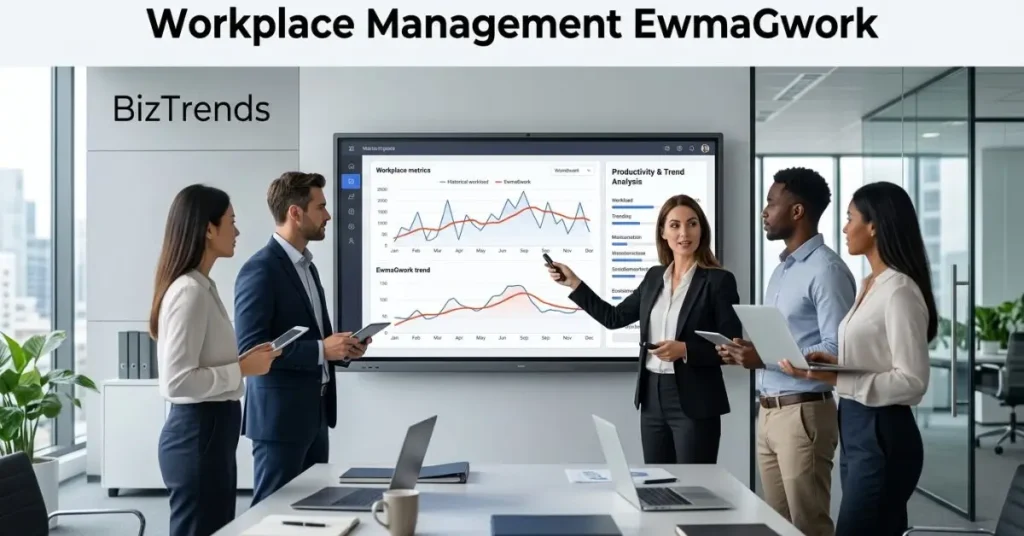
This article breaks down what workplace management actually means, why it’s becoming a priority for forward-thinking businesses in 2024, and how platforms built around this idea including approaches like workplace management ewmagwork are changing how companies operate.
You’ll also find clear answers to the questions most business owners and HR leaders are already asking.
What Is Workplace Management? (Clear Definition)
Workplace management is the process of organizing, coordinating, and optimizing the people, spaces, schedules, and tools inside a business to help work run smoothly and efficiently. It covers everything from how desks are assigned and meetings are scheduled to how teams communicate and how productivity is tracked.
Quick Summary
Workplace management is how businesses organize their people, spaces, and systems to get work done better. When it’s done well, employees are clearer, more productive, and less stressed. When it’s ignored, everything quietly falls apart. Platforms focused on workplace management ewmagwork-style solutions help businesses bring order to this complexity.
Why Workplace Management Is Bigger Than You Think
A lot of business owners hear “workplace management” and picture someone adjusting the thermostat or booking a meeting room. That’s understandable, but it completely misses the scale of what this actually involves.
Think about a mid-sized company with 80 employees. At any given time, someone is figuring out who’s in the office, someone else is trying to find a free conference room, a manager is manually tracking hours in a spreadsheet, and HR is wondering why turnover has quietly crept up.
Each of those is a workplace management failure. And each one costs money.
A study by Gallup found that disengaged employees cost U.S. businesses roughly $1.9 trillion in lost productivity every year. A significant portion of that comes from poor organization, unclear processes, and weak communication systems all things that fall under workplace management.
The point isn’t to scare anyone. It’s to be honest about how much this topic actually matters.
The Core Areas of Workplace Management
Good workplace management doesn’t mean micromanaging people. It means building systems that make work easier, clearer, and more consistent. Here are the areas that matter most.
Space Planning and Office Coordination
In a world where hybrid work is the new normal, physical space needs to be managed smarter.
That means knowing which desks are in use, which meeting rooms are booked, and how often the office is actually at capacity. Companies wasting money on office space they don’t need or cramming too many people into too little space are both workplace management failures.
Tools that handle desk booking, room scheduling, and space analytics solve this without requiring a full-time coordinator to manage it manually.
Example: A Chicago-based marketing agency reduced its office footprint by 30% after using a space management system that showed only 45% of desks were being used at peak times. They saved over $80,000 annually in real estate costs.
Employee Scheduling and Time Tracking
This sounds simple. It’s not.
Managing shifts, tracking hours, handling time-off requests, and making sure the right people are available at the right times is genuinely complex especially for businesses with remote, hybrid, or shift-based teams.
Manual tracking leads to errors. Errors lead to payroll mistakes. Payroll mistakes lead to employee frustration. It’s a chain reaction that’s entirely avoidable.
Good workplace management platforms automate much of this. Schedules are visible, requests are handled digitally, and managers spend less time on admin and more time on actual leadership.
Communication and Workflow Systems
Poor communication is the silent killer of team productivity.
When people don’t know who’s responsible for what, when deadlines aren’t clearly tracked, or when important updates get buried in long email threads, work slows down. People duplicate effort. Decisions get delayed.
Workplace management in this area means putting clear workflows in place. It means using tools that centralize communication, assign tasks clearly, and keep everyone aligned without creating more noise.
Performance and Productivity Tracking
Tracking performance doesn’t mean watching people. It means having visibility into how work is actually getting done.
Are certain teams consistently overloaded? Are some roles unclear? Are there bottlenecks in approval processes that no one has stopped to fix?
Good workplace management surfaces these patterns so leaders can act on them. Not to punish, but to improve.
Compliance and HR Integration
Workplace management also connects to compliance making sure the business meets labor laws, tracks required documentation, and handles employee records properly.
This is especially important in the U.S., where employment law varies by state and non-compliance can lead to significant fines.
Where Platforms Like EwmaGwork Fit In
The idea behind workplace management ewmagwork-style platforms is to bring these separate functions scheduling, space planning, communication, tracking under one connected system.
Instead of using five different tools that don’t talk to each other, businesses use an integrated platform that gives managers a clear, real-time view of how their workplace is operating.
This matters for a few key reasons:
Fewer errors. When data flows between systems automatically, manual entry mistakes go down.
Better decisions. Managers can see what’s actually happening not what they think is happening.
Saved time. Administrative tasks that used to take hours can be handled in minutes.
Happier employees. When scheduling is fair, communication is clear, and processes actually work, people feel more supported.
Common Mistakes Businesses Make With Workplace Management
Even companies that care about this area make predictable mistakes. Here are the most common ones.
Relying too heavily on manual processes. Spreadsheets are useful for many things. Managing a workforce of 50+ people is not one of them.
Treating it as an HR-only concern. Workplace management affects operations, finance, and leadership too. It shouldn’t sit in one department’s silo.
Implementing tools without training. Buying software is easy. Getting people to actually use it consistently is the hard part. Rollout needs proper onboarding.
Ignoring employee feedback. The people doing the work every day often have the best insight into what’s broken. Most companies don’t ask.
Setting and forgetting. Workplace management systems need regular reviews. What worked a year ago may not work now, especially if the team has grown or shifted to hybrid.
A Simple Workplace Management Checklist
| Area | Key Question | Good Sign | Warning Sign |
|---|---|---|---|
| Space Planning | Are we using our office efficiently? | Data-driven desk usage | Empty floors, overbooked rooms |
| Scheduling | Is shift and time management smooth? | Automated, error-free | Manual tracking, constant errors |
| Communication | Do teams know what they’re doing? | Clear workflows | Constant confusion, email overload |
| Performance Visibility | Can managers spot problems early? | Regular data reviews | Surprises at year-end |
| Compliance | Are employee records and processes legally sound? | Documented, updated | Inconsistent, undocumented |
Getting Started: What to Do First
If workplace management is a weak spot in your business, here’s a realistic starting point.
Audit before you buy anything. Understand where the friction is first. Talk to team leaders and employees. Find out where time is being wasted and where decisions are getting stuck.
Pick one area to fix. Don’t try to overhaul everything at once. Start with scheduling, or space management, or communication whichever is causing the most pain.
Choose scalable tools. Whatever platform you choose, make sure it can grow with you. A tool that works for 20 people should also work for 200.
Measure what changes. Set a baseline before you start, then track whether things actually improve. This also helps you justify the investment to stakeholders.
Review regularly. Workplace management is not a one-time project. Build a habit of reviewing systems every six to twelve months.
Conclusion
Workplace management isn’t a buzzword or a luxury for large corporations. It’s the daily infrastructure that determines whether your team works with clarity or constant confusion.
If any part of this guide has highlighted something in your own business that needs attention, that’s a good starting point. Pick one area, improve it, and build from there.
For more practical business guides like this one, explore what Biz Trends covers across operations, growth, and team management.
Frequently Asked Questions
What does workplace management include?
Workplace management covers how a business handles people, space, schedules, communication, and daily operations. It helps teams work in a more organized and efficient way.
What is EwmaGwork and how does it relate to workplace management?
EwmaGwork is a platform that helps businesses manage scheduling, communication, and workplace operations in one system. It supports smoother workflows and better visibility for managers.
Why is workplace management important for small businesses?
Small businesses cannot afford wasted time, poor scheduling, or unclear processes. Good workplace management helps them stay organized, productive, and ready to grow.
How does workplace management improve employee productivity?
It removes daily confusion by making schedules, tasks, and communication clearer. When employees know what to do and have the right systems, they work better and faster.
What is the difference between workplace management and facilities management?
Facilities management focuses on the building, equipment, and physical space. Workplace management is broader and also includes people, workflows, scheduling, and team coordination.